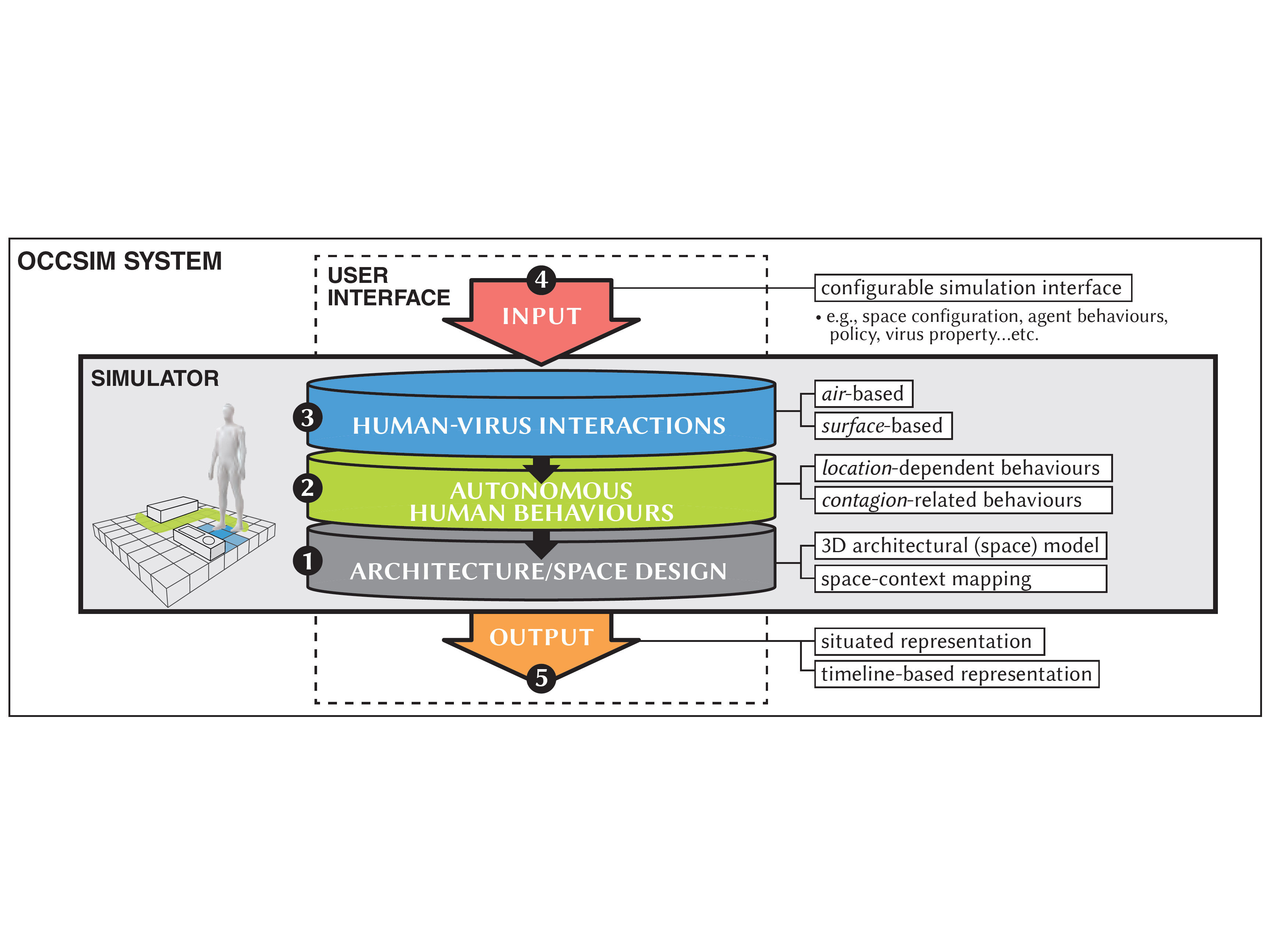
tl;dr: OccSim simulates occupant behaviors in 3D building models to assess virus transmission risks over time. Tested with multiple stakeholder groups, it helped identify specific hazards and informed decisions on safer building design, operation, and policy.
The COVID-19 pandemic changed our lives, forcing us to reconsider our built environment, architectural designs, and even behaviours. Multiple stakeholders, including designers, building facility managers, and policy makers, are making decisions to reduce SARS-CoV-2 virus transmission and make our environment safer; however, systems to effectively and interactively evaluate virus transmission in physical spaces are lacking. To help fill this gap, we propose OccSim, a system that automatically generates occupancy behaviours in a 3D model of a building and helps users analyze the potential effect of virus transmission from a large-scale and longitudinal perspective. Our participatory evaluation with four groups of stakeholders revealed that OccSim could enhance their decision making processes by identifying specific risks of virus transmission in advance, and illuminating how each risk relates to complex human-building interactions. We reflect on our design and discuss OccSim’s potential implications in the domains of "design evaluation", "generative design", and "digital twins".